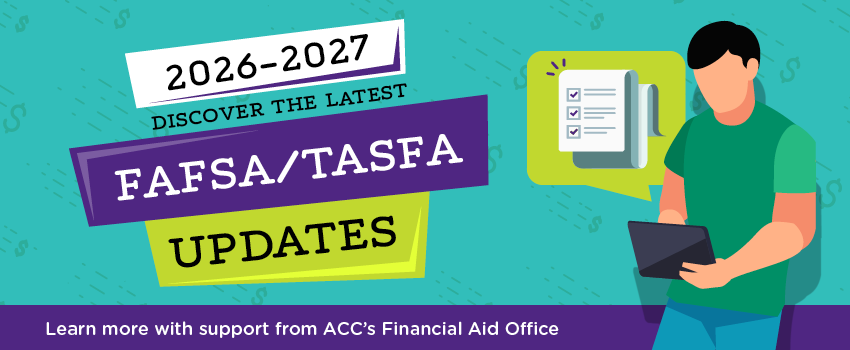
The Free Application for Federal Student Aid (FAFSA) and the Texas Application for State Financial Aid (TASFA) have some changes for the 2026–2027 school year. These updates are the result of new federal and state laws and may affect how financial aid is processed.
What’s New for 2026–2027
FAFSA (for U.S. Citizens & Eligible Non-Citizens)
| FAFSA (for U.S. Citizens & Eligible Non-Citizens) | |
| New Federal Legislation | The One Big Beautiful Bill Act made changes to Pell Grant eligibility, federal loan amounts, and repayment options. Most of these changes go into effect July 1, 2026, and will impact the 2026–2027 school year. See the key changes below. |
| Updates to the FAFSA Form | The FAFSA application process remains the same. Most students will move through without any changes. In some cases, you may be prompted to confirm your identity using a government-issued photo ID, such as your driver’s license. This is a new feature designed to protect students from fraud. To be prepared, have your ID with you before you start. |
TASFA (for Non-Citizens with Texas Residency & Nonresidents)
TASFA (for Non-Citizens with Texas Residency & Nonresidents)
The TASFA is governed by Texas state law and is not impacted by the federal One Big Beautiful Bill Act (OBBBA).
Changes to Texas state law introduced residency requirements that impact a student’s eligibility for state financial aid. To qualify for state aid, one must now be able to demonstrate lawful presence.
| If you can demonstrate lawful presence You may qualify for state financial aid through the TASFA. Visit ACC’s Enrollment and Records website to see what documents qualify. |
If you cannot demonstrate lawful presence Complete the TASFA. ACC will still use the TASFA to consider you for institutional funds. |
No matter your situation, we encourage all students who do not qualify for the FAFSA to submit the TASFA instead. Contact the Financial Aid Office if you have questions about your specific situation.
Key Changes to Know for 2026-2027
Pell Grant Updates
New eligibility cap based on your SAI
Starting 2026–2027, there is a new limit on Pell Grant eligibility based on your Student Aid Index (SAI). The SAI is a number calculated from your FAFSA that reflects your financial need. You can find yours on your Student Aid Report after submitting your FAFSA at StudentAid.gov.
Students with an SAI of $14,790 or higher will no longer qualify for a Pell Grant. This limit is set at twice the maximum Pell Grant award of $7,395 for 2026–2027.
Note: Most ACC students will not be affected by this change. The majority of Pell Grant recipients have an SAI well below this limit. If you have questions about how this may impact your financial aid, contact the Financial Aid Office. We’re here to help you understand your options and what these changes may mean for you.
Scholarships or non-federal grants that cover your full cost of attendance
If you receive non-federal grants or scholarships (from a state program, a private organization, or ACC) that fully cover your cost of attendance, you will no longer be eligible for a Pell Grant on top of that.
ACC’s cost of attendance ranges from approximately $18,000 to $35,000 per year, depending on your situation, including tuition, fees, books and supplies, housing, transportation, and more.
Note: Most ACC students receiving a Pell Grant are unlikely to reach this limit. Even students who receive ACC Free Tuition or outside tuition assistance (such as Capital Idea) are unlikely to be impacted by this change. If you are unsure how this may impact you, contact the Financial Aid Office, and we can help you understand what that means for your financial aid.
Family farm and small business assets
If your family owns a farm or small business with under 100 employees, those assets will not count against you in your financial aid calculation.
Workforce Pell Grant — Coming in the Future
Current Status: This program is not yet available at ACC. Before any programs can be funded, approvals are needed at the federal level, the state level (through the Texas Higher Education Coordinating Board), and then at the institution. This is a multi-step process, and no programs can launch until all three levels have signed off.
We expect Workforce Pell to be available at ACC no earlier than Spring 2027. We will share updates as they become available.
About: The One Big Beautiful Bill Act (OBBBA) expanded Pell Grant funding to include some short-term, career-focused training programs, now referred to as the Workforce Pell Grant. Eligible programs must be 8 to 14 weeks long, consist of 150 to 599 hours of instruction, be aligned with high-demand careers, and lead to a portable, stackable credential.
This is an expansion of the existing Pell Grant, not a separate grant, and it counts toward a student’s overall Pell eligibility.
Federal Loan Changes
Loan amounts will be adjusted based on your enrollment
Starting Fall 2026, your federal loan offer will be calculated based on how many credit hours you are enrolled in, similar to how Pell Grants already work.
- Full-time (12 or more credits): You will receive the maximum loan amount.
- Below 12 credits (11- 6 credits): Your loan amount will be reduced depending on the number of credit hours you have enrolled (example below).
- Less than half-time (fewer than 6 credits): You are not eligible for federal student loans.
Example: Loan amounts by enrollment level (per semester)
| Credits Enrolled | Loan Offer |
| 12+ credits (full-time) | $1,750 |
| 9 credits (three-quarter time) | $1,313 |
| 6 credits (half-time) | $875 |
Dropping classes could impact your future loan amount
If you drop below the enrollment level used to calculate your loan, it won’t change what you already received, but it can reduce how much you’re eligible for in future semesters within the same school year. We strongly recommend speaking with the Financial Aid Office before making any enrollment changes.
Example: A student receives $1,750 in the fall based on full-time enrollment, then drops to 6 credit hours after disbursement. Because their annual eligibility is based on their enrollment across both semesters, dropping in the fall reduces what is left for spring.
| Fall | Spring | |
| Enrollment | 12 credits (dropped to 6 after disbursement) | 12 credits |
| Loan Offer | $1,750 |
New limits on Parent PLUS Loans
Starting July 1, 2026, parents who borrow a Parent PLUS Loan on behalf of a dependent student will have new annual and lifetime limits:
- Annual limit: $20,000 per dependent student
- Lifetime limit: $65,000 per dependent student (combined across all parents)
Parents who borrowed a Parent PLUS Loan before July 1, 2026, may be able to continue borrowing under the previous rules for up to three academic years or the remainder of their student’s program, whichever comes first.
There is now a $257,500 lifetime limit on all federal student loans combined. This limit does not include Parent PLUS Loans.
For most ACC students, this limit is unlikely to be reached at the community college level.
Loan Repayment Updates
Most borrowers can stay on their existing repayment plans. However, if you are currently enrolled in an Income-Contingent Repayment (ICR), Pay As You Earn (PAYE), or SAVE plan, you will need to transition to a different repayment plan by July 1, 2028.
The Public Service Loan Forgiveness (PSLF) program remains unchanged. For support with loan repayment, visit austincc.edu/loanrepayment.
Students who take out loans on or after July 1, 2026, will have two repayment options:
- Tiered Standard Plan: repayment over 10 to 25 years based on your loan balance
- Repayment Assistance Plan (RAP): an income-driven option where your payment is based on what you earn
The Public Service Loan Forgiveness (PSLF) program remains unchanged. For support with loan repayment, visit austincc.edu/loanrepayment.
Frequently Asked Questions
General Questions
What is the FAFSA, and how do I apply?
The Free Application for Federal Student Aid (FAFSA) is the first step to getting financial aid at ACC. It determines your eligibility for federal and state grants, work-study, and loans. Most students qualify for some form of assistance, so we encourage everyone to apply.
To apply, complete the FAFSA and include ACC’s school code: 012015. Apply as early as October for the best chance at available funding — some aid is first-come, first-served.
What is the TASFA, and how do I apply?
The Texas Application for State Financial Aid (TASFA) is for students who do not qualify for federal financial aid. It is the state equivalent of the FAFSA and determines eligibility for Texas state and institutional financial aid programs.
If you do not qualify for federal financial aid, we encourage you to apply for TASFA.
To apply, complete the TASFA and include ACC’s school code: 012015. Apply as early as October for the best chance at available funding — aid is first-come, first-served.
What is the One Big Beautiful Bill Act?
The One Big Beautiful Bill Act (OBBBA) is a federal law signed on July 4, 2025. It includes changes to federal student financial aid programs. Most changes take effect July 1, 2026, and will apply starting with the 2026-2027 school year.
Texas state law governs any TASFA-related changes separately.
Will these changes affect my 2025-2026 financial aid?
No. If you are enrolled in 2025-2026, your aid is unchanged. These changes apply starting with the 2026-2027 school year (Fall 2026 and beyond).
What if my financial aid doesn't cover my full cost of attendance?
Financial aid may not cover all your expenses associated with going to school. If you’re looking for help managing all your expenses, ACC offers financial coaching for enrolled students. Our partner Foundation Communities also offers free financial coaching, and you can schedule a free session here: foundcom.org/financial-coaching.
Financial coaching can help you build a budget, plan for expenses, and make the most of your resources.
Pell Grant
I am expecting a scholarship. How does this impact my Pell Grant?
A scholarship won’t affect your Pell Grant unless your total non-federal aid (scholarships + other grants) covers your entire cost of attendance (COA). Since ACC’s COA ranges from $18,000–$35,000 per year, this threshold is high enough that most students won’t reach it.
If your non-federal aid does cover the full COA, you would no longer be eligible for a Pell Grant.
How does my enrollment level affect my Pell Grant?
Your Pell Grant amount is based on how many credits you are taking (same as prior years).
- Full-time enrollment (12 or more credits) qualifies you for the full Pell Grant amount.
- If you are enrolled part-time, your Pell Grant amount is reduced based on how many credits you are taking.
This is called Pell Grant Enrollment Intensity.
I am enrolled in a workforce program at ACC. Could it be eligible for Workforce Pell funding?
Workforce Pell programs are not yet available at ACC. We expect them to be available no earlier than Spring 2027 and will share updates as they become available.
In the meantime, if you are enrolled in a credit program, you can check the Eligible Programs and Classes page to see if your program qualifies for existing Pell Grant funding. Contact the Financial Aid Office if you have questions about your current aid eligibility.
Note: ACC faculty and staff can review the Texas Higher Education Coordinating Board’s Workforce Pell Grant page for more details on program eligibility requirements.
Loans
How will my loan amount be calculated if I am taking fewer than 12 credits?
Starting Fall 2026, your federal loan offer will be adjusted based on how many credit hours you are enrolled in, similar to how Pell Grants already work.
- Full-time (12 or more credits): Your loan amount will not change.
- Below 12 credits (11- 6 credits): Your loan amount will be reduced depending on the number of credit hours you have enrolled (example below).
- Less than half-time (fewer than 6 credits): You are not eligible for federal student loans.
Example: Loan amounts by enrollment level (per semester)
| Credits Enrolled | Loan Offer |
| 12+ credits (full-time) | $1,750 |
| 9 credits (three-quarter time) | $1,313 |
| 6 credits (half-time) | $875 |
Can I take the full annual loan amount in one semester?
No. Federal regulations require that your annual loan eligibility be split across the school year. In most cases, you can only receive up to half of your annual loan limit per semester (for example, $1,750 subsidized and $1,000 unsubsidized per semester for a loan limit of $5,500).
Will my subsidized loans change?
No. An earlier version of the bill proposed eliminating subsidized loans, but that provision was not included in the final legislation. Subsidized loans remain available as before.
What if I cannot afford my loan payments? Are there still hardship options?
If you are struggling with repayment, contact your loan servicer as soon as possible. The new Repayment Assistance Plan (RAP) is an income-driven option that may help lower your monthly payment based on your earnings. For guidance on your options, visit austincc.edu/loanrepayment or contact the Financial Aid Office.
We’re here for you.
ACC’s Financial Aid Office is ready to help you navigate what is new and make sure you are set up for success.
Contact ACC’s Financial Aid Office
Tags: fafsa, OBBBA, Pell Grant, tasfa
Back to Top